
















Now Reading: Facial Recognition Vending Machine Blocks Junk Food in UAE Schools
-
01
Facial Recognition Vending Machine Blocks Junk Food in UAE Schools
Facial Recognition Vending Machine Blocks Junk Food in UAE Schools
Advertisement

A UAE school vending machine now uses facial recognition to restrict unhealthy food choices for students. Here's how the tech works and why it matters.
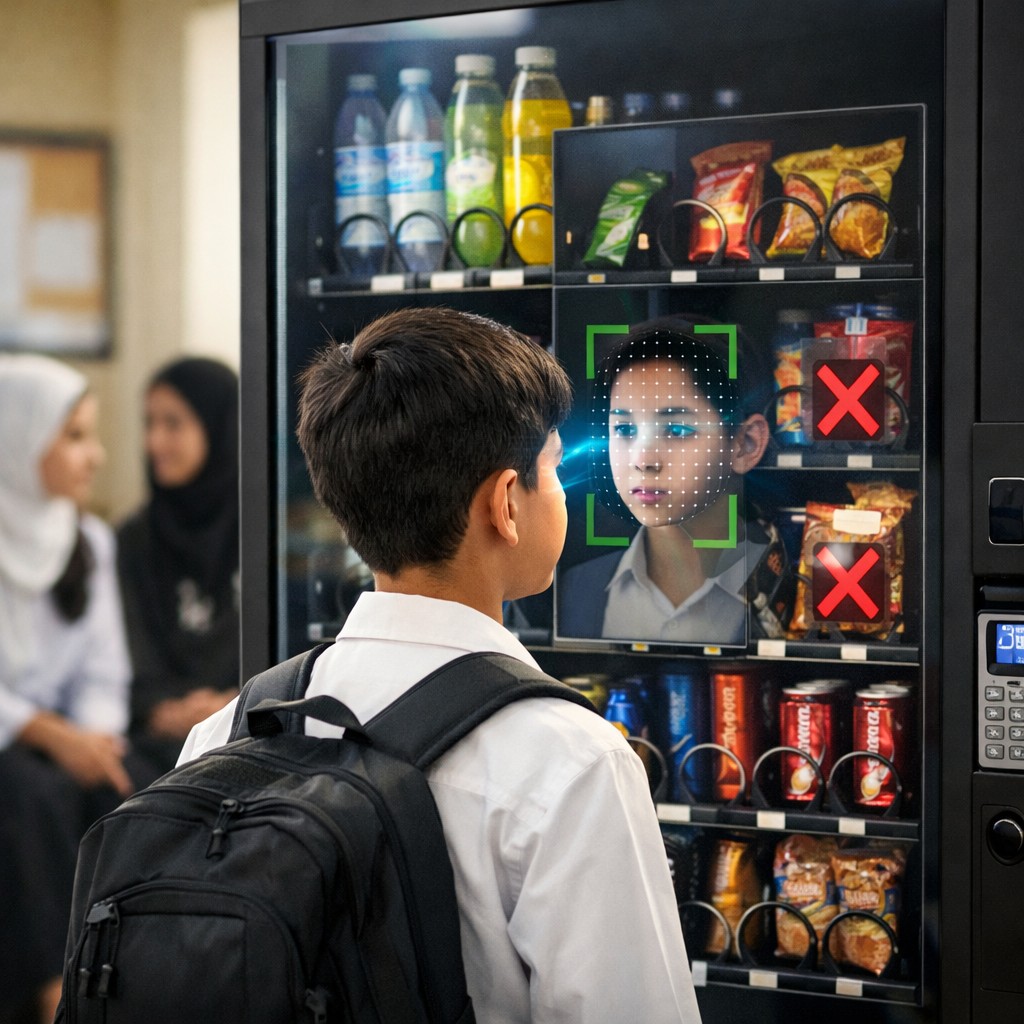
A vending machine installed in a UAE school is using facial recognition technology to identify students and block their access to less healthy food and drink options. The system scans a student’s face, determines their profile, and restricts certain products accordingly, putting automated nutrition control directly at the point of sale.
How Does the Facial Recognition Vending Machine Work?
The machine reads a student’s face and cross-references it with a stored profile that includes age, dietary flags, or school-set restrictions. Based on that data, it either permits or denies the purchase of specific items. Healthier options remain accessible while snacks or drinks deemed less suitable are locked out for that individual user.
This moves beyond the standard PIN or card-based canteen systems already used in some UAE schools, replacing manual oversight with real-time, automated decision-making built into the hardware itself.
Which School Is Using This Technology?
The specific school and vending supplier have been reported by The National in its original report. The initiative represents one of the more hands-on applications of biometric technology in the UAE’s education sector to date.
Why It Matters for the Gulf
The Gulf region has long grappled with rising rates of childhood obesity and diet-related health concerns. The UAE government has made student wellness a stated policy priority, with schools increasingly required to meet canteen nutrition standards set by health authorities.
Automating that enforcement through facial recognition removes the burden from teachers and canteen staff, and it removes the choice entirely from students when certain products are off-limits. That is a significant shift from guidance-based approaches to a hard technical restriction.
How This Compares to Existing School Food Controls
| Method | How It Works | Enforcement |
|---|---|---|
| Traditional canteen menus | Pre-approved items only sold on-site | Staff-dependent |
| Smart card payment systems | Parents set spending limits via app | Financial cap only |
| Facial recognition vending | Biometric ID restricts product access | Automated, per student |
Privacy Questions Around Biometric Data in Schools
Any system collecting and processing children’s facial data raises legitimate questions. Schools would need robust data governance policies, parental consent frameworks, and clear limits on how long biometric data is stored and who can access it.
The UAE has data protection legislation under Federal Decree-Law No. 45 of 2021, but applying those rules specifically to minors in educational settings remains a conversation the sector is still working through. How schools communicate these policies to parents will be as important as the technology itself.
Could This Spread to Other UAE Schools?
If the pilot demonstrates measurable improvements in student nutrition or reduces canteen-related complaints, other schools and school networks could adopt similar systems. The UAE has a track record of scaling successful edtech and smart-infrastructure pilots quickly, particularly in Abu Dhabi and Dubai.
Vendors operating in this space will be watching closely. A proven, compliant model in a UAE school could open doors across the wider GCC, where school nutrition policies are tightening in Saudi Arabia, Qatar, and Kuwait as well.
Disclaimer: This article covers a technology with health and data privacy implications. Readers with concerns about biometric data use in schools should consult their institution’s official data protection policy.
Would you want facial recognition technology managing what your child can buy at school, or does that cross a line? Share your thoughts in the comments below.

Related Posts


Stay Informed With the Latest & Most Important News
Previous Post
Next Post







Advertisement

-
 01UAE Team Emirates Stays Close in UCI Rankings Thanks to Tuckwell
 -
 02UAE E-Commerce Trends 2026: Why the Market Moves Fast
 -
 03Dubai Summer Surprises 2026: Full Arab Concert Lineup
 -
 04Sheikh Mohamed at G7: UAE Pledges Global Stability Role
 -
 05Windshield Sunshade in UAE Heat: Does It Actually Work?
 -
 06UAE Stocks Rally as Iran Ceasefire Talks Lift Gulf Markets
 -
 07Gulf Investors Blocked by European Rules, Saudi PIF Warns