

















Now Reading: Business Jet Departures in the Middle East Fell 30% Amid Iran Conflict
-
01
Business Jet Departures in the Middle East Fell 30% Amid Iran Conflict
Business Jet Departures in the Middle East Fell 30% Amid Iran Conflict
Advertisement

Business jet departures in the Middle East dropped 30% during the Iran conflict. Here's what that means for Gulf aviation and regional travel demand.
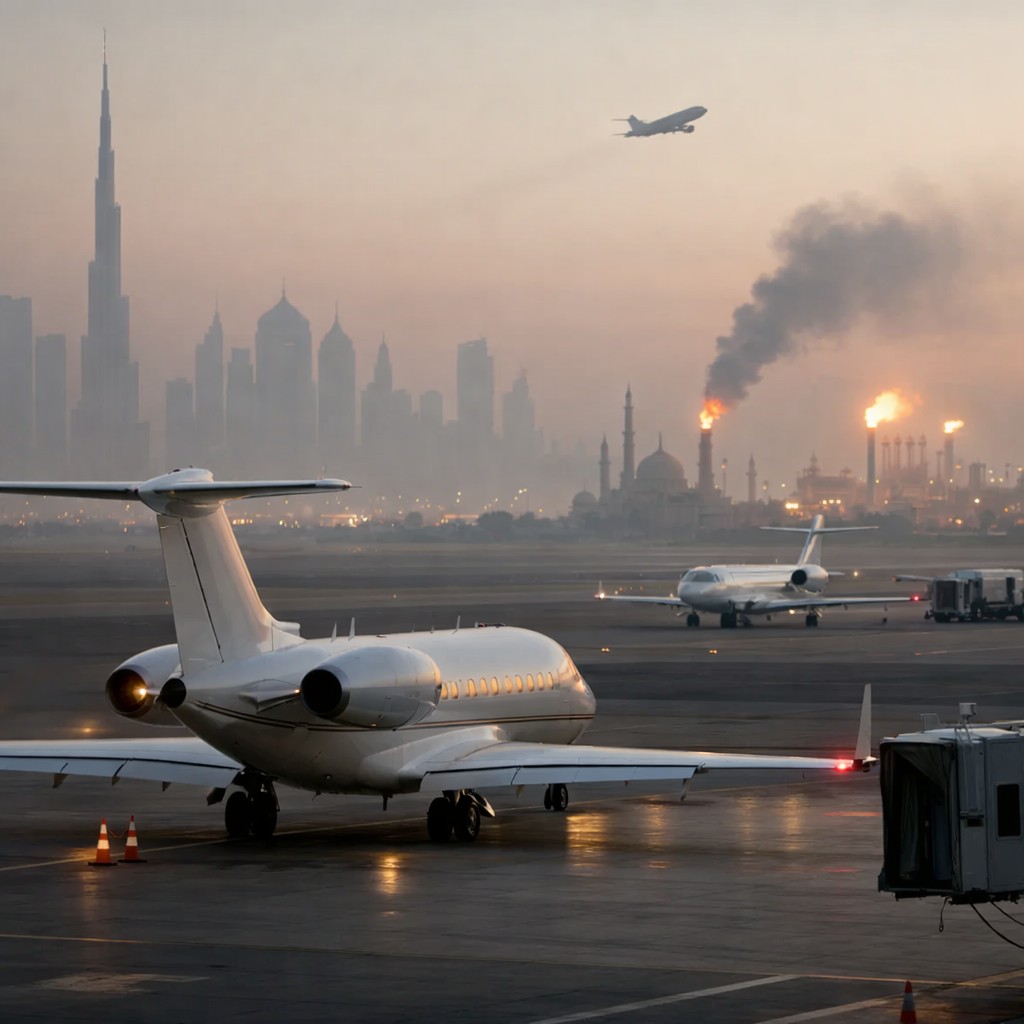
Private aviation in the Middle East took a sharp hit during the recent Iran conflict, with business jet departures falling roughly 30%, according to data reported by Bloomberg. The drop reflects how quickly high-net-worth travelers and corporate operators pull back when regional security deteriorates, and the numbers underline the Gulf’s exposure to geopolitical shocks.
What happened to private jet traffic during the Iran conflict?
When tensions between Iran and its adversaries escalated into open conflict, operators and passengers didn’t wait for conditions to worsen. Departures across the Middle East fell by around 30%, a figure that captures both cancelled trips and routes that were rerouted out of the region entirely.
Business aviation is considered a leading indicator of elite economic confidence. Unlike commercial airlines, which operate on fixed schedules and absorb short-term disruptions, private charter and ownership decisions are made in real time, making the sector a sensitive barometer of sentiment.
Why does this matter for the Gulf specifically?
The UAE, Saudi Arabia, and Qatar host some of the busiest business aviation hubs in the world. Dubai’s Al Maktoum International and Dubai World Central, along with Abu Dhabi’s hub at Al Bateen Executive Airport, serve as key transit and origin points for private flights connecting Europe, Asia, and Africa.
A 30% demand contraction, even if temporary, ripples through ground handlers, FBOs (fixed-base operators), crew services, and the broader hospitality ecosystem that caters to arriving executives and ultra-high-net-worth individuals. For a region that has invested heavily in positioning itself as a global business crossroads, that kind of disruption is not trivial.
There is also a longer-term reputational dimension. Investors and multinational firms routinely assess regional stability when planning travel schedules and office locations. A sustained pullback in private aviation could signal broader hesitation about the Gulf as a safe base for doing business.
How does the drop compare to other disruptions?
- Iran conflict period: Business jet departures down approximately 30% across the Middle East
- COVID-19 peak (2020): Global private aviation collapsed by over 60% before rebounding sharply
- 2022 Ukraine war outbreak: European private jet traffic fell significantly, though Middle East routes saw an initial spike as operators rerouted
The current drop is notable because it is regionally concentrated and conflict-driven rather than pandemic-related, meaning recovery timelines are harder to predict. Ceasefires and diplomatic signals can shift demand back quickly, but prolonged uncertainty tends to reroute habitual travelers toward alternative hubs like Istanbul or Nairobi.
Will Gulf private aviation recover quickly?
History suggests business aviation bounces back faster than commercial travel after geopolitical events, largely because wealthy clients resume activity as soon as security assessments clear. Operators in Dubai and Riyadh are likely monitoring the situation daily, ready to ramp capacity back up when conditions stabilize.
Gulf carriers and charter operators have significant financial buffers and government backing, which means they can absorb short downturns. The more pressing concern is whether a prolonged conflict could prompt some corporate clients to shift regional headquarters or travel hubs away from the Gulf, a trend that would take years to reverse.
UAE aviation authorities have not issued formal guidance restricting business jet operations as of the time of writing, and commercial airspace over the Emirates has remained largely open, suggesting that operators have been reacting to client caution rather than regulatory closures.
What Gulf travelers and businesses should watch
Airspace closures are the most immediate risk. If Iranian airspace or adjacent corridors are restricted further, routing for flights between Europe and Asia shifts significantly, adding time and cost. The UAE sits at the intersection of those routes, so any escalation would pressure both commercial and private operators simultaneously.
For businesses planning executive travel in the coming weeks, insurance and security briefings from operators will be the first checkpoint. Charter companies are already factoring conflict-risk premiums into pricing for some regional routes, according to industry observers.
Full details and data from the original report are available at the original report via Bloomberg.
Disclaimer: This article covers financial and geopolitical developments. It is intended for informational purposes only and should not be taken as financial or travel-safety advice.
If the conflict eases in the coming weeks, do you think Gulf business aviation will recover fast enough to avoid lasting damage to the region’s reputation as a global hub? Share your view in the comments below.

Related Posts


Stay Informed With the Latest & Most Important News
Previous Post
Next Post






Advertisement

-
 01UAE Team Emirates Stays Close in UCI Rankings Thanks to Tuckwell
 -
 02UAE E-Commerce Trends 2026: Why the Market Moves Fast
 -
 03Dubai Summer Surprises 2026: Full Arab Concert Lineup
 -
 04Sheikh Mohamed at G7: UAE Pledges Global Stability Role
 -
 05Windshield Sunshade in UAE Heat: Does It Actually Work?
 -
 06UAE Stocks Rally as Iran Ceasefire Talks Lift Gulf Markets
 -
 07Gulf Investors Blocked by European Rules, Saudi PIF Warns